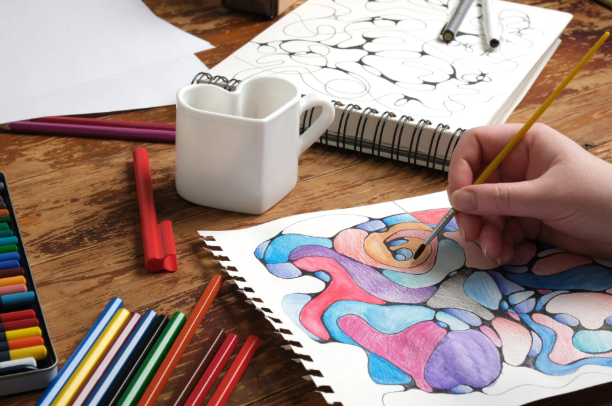
She keeps a list of things she’s bad at. Not on paper — in her head, where it updates automatically. Parallel parking. Small talk. Drawing. Especially drawing. She tried once, in a waiting room, while her daughter colored beside her. A house with a triangle roof and a circle sun. Her daughter glanced over and said, “Mommy, that’s not how houses look.” She put the crayon down and hasn’t picked one up since.
Now her therapist is recommending art therapy exercises. She nods politely, but the objection is already forming: she can’t draw. She’s the spreadsheet person, the logistics person, the one who books the restaurant while everyone else picks the wine.
What she doesn’t know yet — what most people don’t — is that art therapy has almost nothing to do with drawing. And the most effective art therapy exercises don’t ask you to draw at all.
The Misunderstanding That Keeps People Away
The word “art” does most of the damage. It conjures galleries, technique, talent — things most adults decided they didn’t have sometime around the fourth grade. By the time we’re thirty, the verdict feels permanent. Creative expression becomes something other people do, and we become the audience.
But art therapy isn’t about producing art. It’s about using creative processes — movement, color, texture, pressure — to access and regulate emotions that resist verbal expression. The American Art Therapy Association defines it as an integrative mental health profession that uses the creative process to improve well-being. Nowhere in that definition does skill appear. What if you genuinely believe you’re terrible at drawing? It doesn’t matter. Not even slightly.
The therapeutic value lives in the process, not the product. A messy scribble that helps someone externalize anger is doing more clinical work than a technically perfect portrait painted by someone who felt nothing while making it.
Five Exercises That Skip Drawing Entirely
If drawing feels like a locked door, these art therapy exercises use a different entrance.
Color breathing. Choose two colors — one that represents tension, one that represents calm. Close your eyes and breathe. On the inhale, imagine the tension color filling your chest. On the exhale, imagine the calm color replacing it. After a few breaths, open your eyes and put those colors on a page or screen. No shapes. No lines. Just pressure and pigment. The visual becomes a record of the breathing, not a picture of anything.
Tactile collage. Tear paper. Don’t cut it — tear it. The imprecision is the point. Collect textures: magazine pages, fabric scraps, tissue paper. Arrange them based on how they feel, not how they look. Rough beside smooth. Thick beside thin. The hands are doing the thinking, and the thinking is sensory, not aesthetic.
Squeeze and release. On a digital screen, press your finger down hard and drag. Watch the color respond to your pressure — darker where you push, lighter where you ease up. Do it again. And again. This isn’t drawing. It’s a dialogue between your body and the surface. The screen gives back what you give it, and the feedback loop becomes its own form of regulation.
Body mapping. Trace a rough outline of a human figure — or use a printed one. Fill different areas with colors that represent what you feel in those parts of your body. Red in the shoulders. Blue in the stomach. Nothing in the hands because you haven’t noticed your hands in weeks. This doesn’t require artistic ability. It requires attention.
Destructive art. Make something — anything — with the explicit intention of destroying it. Scribble furiously on paper. Build a small structure from scraps. Then tear it, crumple it, flatten it. Some emotions need to be externalized and then discarded. Traditional therapy asks you to talk about anger. This exercise lets you act on it in a contained, safe way.
See also: Boost Your Business 978080692 Marketing Solutions
Why the Body Matters More Than the Brushstroke
Most conventional mental health approaches are top-down: they start with thoughts and try to change behavior. Art therapy often works bottom-up: it starts with the body — with sensation, movement, pressure — and lets cognition follow.
This matters because some emotional states resist language. Trauma, anxiety, grief — these live below the threshold of verbal expression. You can’t always think your way out of a feeling that didn’t start as a thought. But you can press your fingers into color and feel something shift. You can tear paper and notice your breathing slow. The hands know things the mouth can’t say.
Art therapy exercises involving tactile engagement — pressing, tearing, squeezing — activate the somatosensory cortex and stimulate the parasympathetic nervous system. Your body begins to calm down before your mind catches up. That’s not a metaphor. It’s neuroscience.
Permission to Be Bad at It
The biggest barrier to art therapy isn’t time, cost, or access. It’s the belief that you need to be good at art to benefit from it. That belief is wrong, and it’s keeping people from a form of healing that could genuinely help them.
You don’t need steady hands or an eye for composition. You need a willingness to move your hands and pay attention to what happens when you do.
The woman from the opening eventually tried one exercise — the squeeze and release, on her phone, during a lunch break she usually spent scrolling. She pressed her thumb into the screen and watched a bloom of purple spread under the glass. It wasn’t beautiful. It wasn’t ugly. It was just movement and color and three minutes where she wasn’t thinking about the house with the triangle roof.
She did it again the next day. Not because she’d become an artist — because her shoulders were a little lower when she stopped.
That’s what art therapy exercises actually do. They don’t make you creative. They make you present. And for most of us, present is the thing we’ve been missing.